


MedX Therapy
Successful therapies are generally based on precise knowledge of the emergence of a problem. Atrophy in the musculature of the lower back is considered the primary risk factor for pain and associated problems.
This is where MedX therapy is beneficial.
First the muscles are tested to reveal any functional deficits the patient may have. Next a program is developed for therapy and the treatment is documented to measure the effectiveness.
To perform a functional analysis of the spinal muscles, the following prerequisites must be fulfilled:
- Isolation of the lumbar extensor muscles by pelvic fixation
- Elimination of gravitational pull on the body and upper body mass
- Measurement of soft tissue tension and the net muscle force
- Isometric testing over the entire range of motion (ROM)
- Muscle fiber typing by exhaustion reaction
This extensive diagnosis provides the basis for the patient’s treatment plan. The data obtained is compared with age, sex and weight specific standardized data from the University of Florida study.
The aim of the MedX therapy is to restore the function of the spinal column in areas of strength, agility, and endurance. By actively reconditioning the muscle these results are attainable.
The computer-assisted therapy devices, such as the Lumbar Extension Machine (LE) and Cervical Extension Machine (CE), provide an isolated and controlled training of the lumbar and cervical spine muscles. The stable pelvic fixation reduces the contribution of synergistic muscle groups. This allows the lumbar extensors to be tested and trained in a targeted manner.
Figures 1-3 illustrates the isolated movement amplitudes and test positions on the therapy machines for lumbar extension and cervical extension. For the lumbar extension, an isometric force measurement is made at seven different test positions at every 12° of the movement. For the cervical extension there is eight test positions at every 18°. The test involves an isolated movement over the full range, up to 72° for lumbar extension and 126° for cervical extension.
Specific training of the lumbar extensors has been investigated in clinical studies involving people with chronic low back pain. Improvements in lumbar strength, pain and functional impairment have been reported. The results relate to the patient groups and training protocols examined in the respective studies; they do not guarantee an individual treatment outcome.
Figure 1:
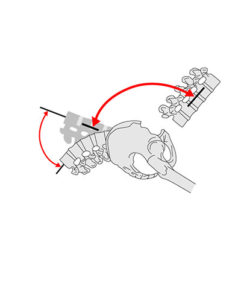
The straightening of the upper body is a complex movement with a movement angle of 182°. If the movement amplitude of the pelvis is considered separate from the movement of the spine, the pelvis has an amplitude of 110° but the spine only measures 72°. Thus the lumbar spinal musculature only contributes 72° to spinal extension.
Figure 2:
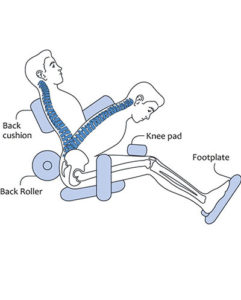
Schematic representation of the patented MedX Pelvic Fixation system.
Figure 3:
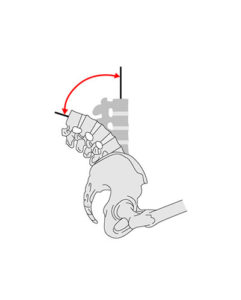
Isolated lumbar spinal extension through pelvic fixation in the MedX lumbar extension machine.